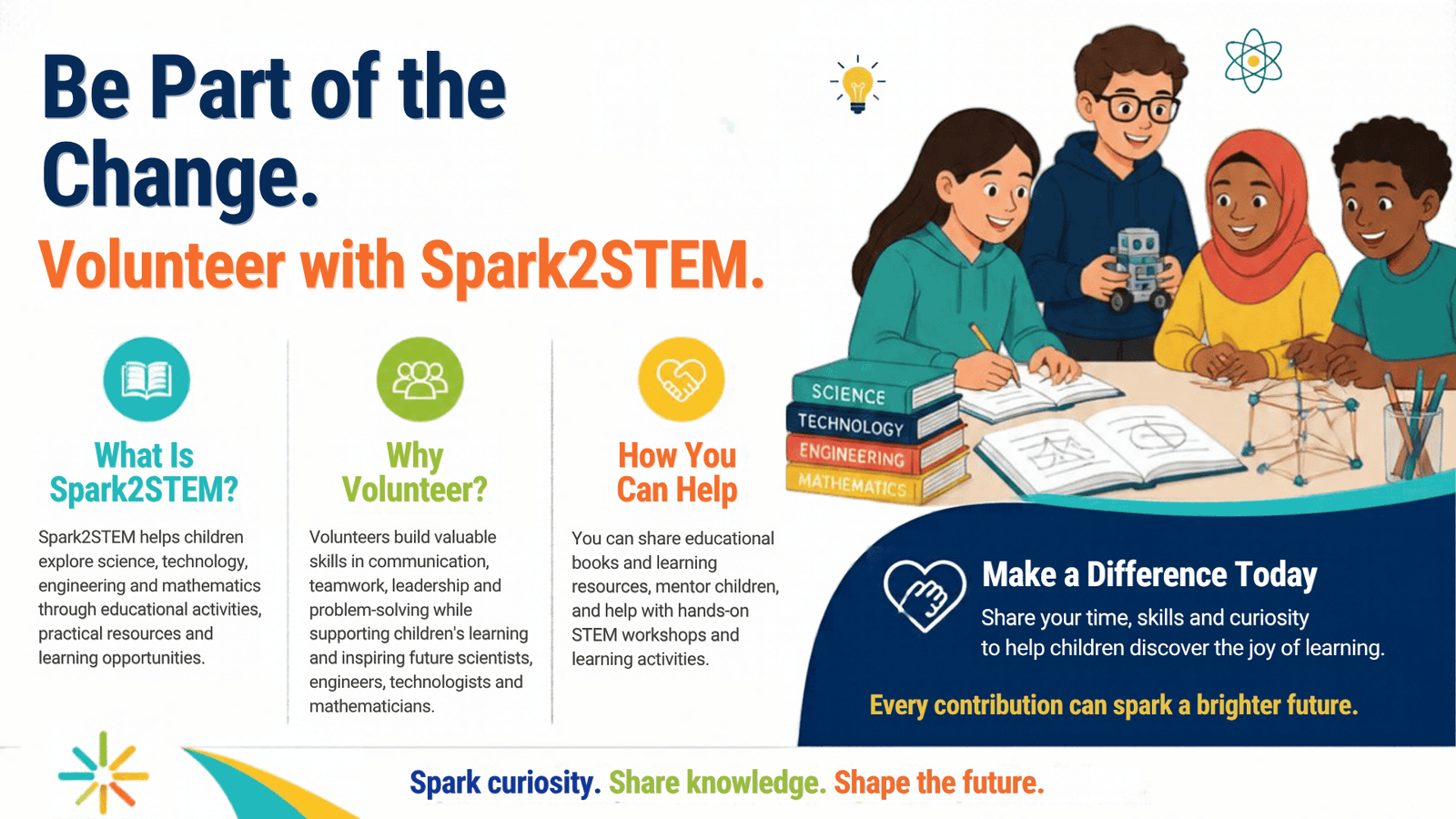
What if your skills could help a child discover a passion for science, technology, engineering, or mathematics?
Learning can open doors to new ideas, possibilities, and opportunities. But not every child has access to engaging educational resources or the support they need to explore these subjects. Spark2STEM aims to help address this by encouraging people to contribute to STEM education and make learning more accessible and engaging for young learners.
Whether you enjoy writing, designing, researching, coding, or explaining ideas, there may be a way for you to contribute. You don’t need to be an expert in everything. Sometimes, the most valuable contribution begins with a skill you already have.
What Is Spark2STEM?
Spark2STEM is an initiative centred on STEM education and the power of people working together to support learning.
STEM stands for Science, Technology, Engineering, and Mathematics. These subjects help children develop curiosity, logical thinking, creativity, and problem-solving skills. They also encourage young learners to ask questions, experiment with ideas, and understand how the world around them works.
However, STEM education should be more than memorising facts or reading complicated explanations. Children benefit from resources that make difficult concepts easier to understand and encourage them to explore further.
By contributing time, knowledge, creativity, and technical skills, volunteers can help create educational opportunities that inspire the next generation of learners.
Why Does STEM Education Matter?
The world is becoming increasingly shaped by technology, scientific discoveries, and engineering innovations. Helping children explore STEM from an early age can encourage them to become curious, confident learners who are willing to investigate problems and develop their own ideas.
STEM learning can help children:
- Develop problem-solving skills: Learn to approach challenges logically and explore possible solutions.
- Build creativity: Turn questions and ideas into experiments, designs, and projects.
- Understand the world: Discover the science behind everyday experiences, from how plants grow to how rockets travel into space.
- Explore future possibilities: Become familiar with subjects and skills that may support their future studies and careers.
- Become lifelong learners: Develop the confidence to ask questions and keep discovering new things.
Access to educational resources is an important part of this process. A clear explanation, an engaging activity, or a well-designed learning resource can help make an unfamiliar subject feel more approachable.
Why Should You Volunteer?
Volunteering is an opportunity to use your abilities to contribute to something beyond yourself. With an educational initiative, your contribution can help other people learn while allowing you to develop your own skills.
You don’t have to wait until you have years of experience or professional qualifications. What matters is being willing to contribute, collaborate, and learn.
Volunteering can help you:
Put your skills to use. Apply your interests in writing, technology, design, research, or communication to a meaningful educational project.
Learn through experience. Working on real tasks can help you improve your abilities, discover new interests, and understand how ideas become useful resources.
Collaborate with others. Educational projects often bring together people with different strengths. Working together helps turn individual contributions into something more useful.
Contribute to learning opportunities. Your work may help create resources that children can use to explore STEM concepts and develop their curiosity.
Build a sense of purpose. Volunteering gives you an opportunity to connect your interests with a goal that benefits others.
The value of volunteering is not measured only by how much time you spend or how complicated your work is. A thoughtful contribution can be useful, especially when it supports a shared purpose.
How Can You Help Spark2STEM?
There are many ways people can contribute to STEM education. The right opportunity depends on your interests, abilities, and the volunteering activities currently available through Spark2STEM.
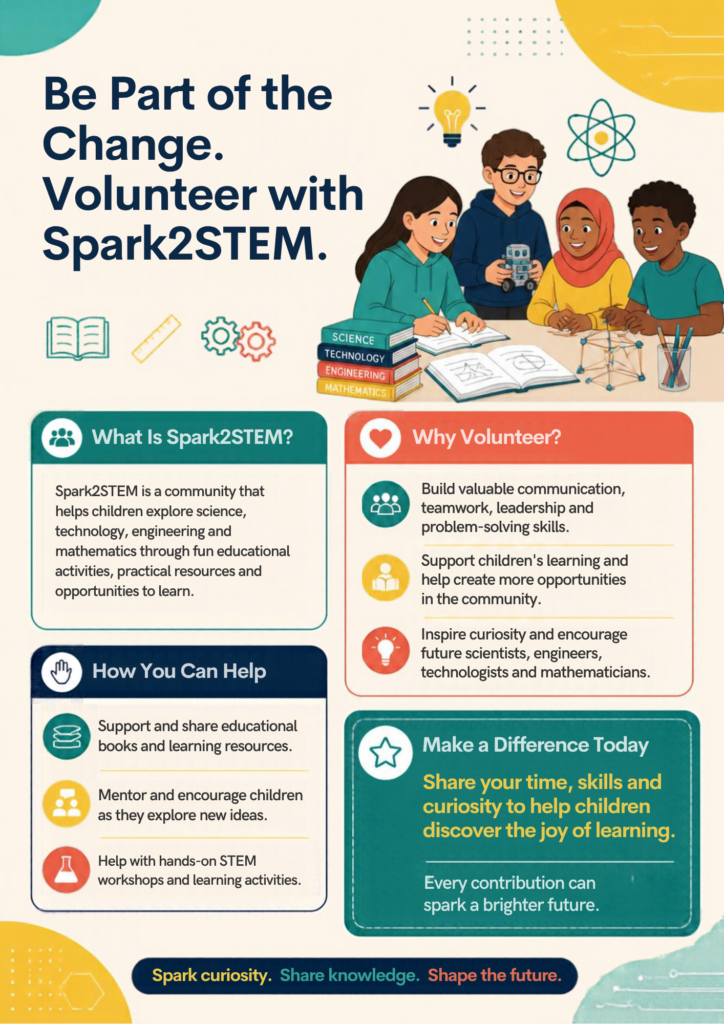
1. Create educational content
If you enjoy writing or researching, you could contribute to educational books, articles, explanations, activity sheets, or other learning resources. The goal is to help make STEM concepts easier for children to understand.
2. Use your design and creative skills
Illustrations, page layouts, diagrams, and visual explanations can make educational material more engaging. Creative contributions can help transform a complicated idea into something young readers can follow.
3. Contribute through technology
If coding and technology interest you, consider opportunities involving educational websites, digital learning resources, interactive activities, or other technology-based projects.
4. Share your knowledge
You might enjoy explaining a scientific concept, helping someone understand a difficult topic, or developing an activity that encourages children to ask questions. Sharing knowledge can be a meaningful way to support learning.
5. Collaborate and spread awareness
You can help more people discover educational initiatives by sharing official information with classmates, friends, teachers, and others who may be interested. You can also collaborate with other volunteers when opportunities are available.
You don’t need to do all these things. Start with the skills you have and explore where they might be useful.
My Experience with Spark2STEM
As part of my experience with Spark2STEM, I created three children’s STEM books: How the Brain Works, How Rockets Work, and How Seeds Grow. Working on these books gave me an opportunity to explore different scientific topics and think about how to explain them in a way that young readers could understand. It also showed me how writing and creativity can be used to contribute to education, and how something you create can potentially help someone else learn.
Be Part of the Challenge
You might be wondering where to begin. The first step is to explore Spark2STEM’s official information and find out which volunteering opportunities and participation requirements are currently available.
Here’s how you can get started:
- Learn about Spark2STEM. Read the initiative’s official information to understand its purpose and activities.
- Identify your strengths. Think about what you enjoy, whether it is writing, research, design, coding, or explaining ideas.
- Explore the available opportunities. Check the official challenge or volunteering page for the roles, requirements, and instructions.
- Follow the participation process. Use the official sign-up or contact method provided by the organisers, if available.
- Contribute and collaborate. Be ready to learn, work with others, and use your skills to support the initiative’s goals.
If you are unsure which role would suit you, look for the organisers’ guidance on how volunteers can contribute.
Every Contribution Can Be a Starting Point
Making STEM education more accessible is a shared effort. It can involve educators, students, writers, designers, developers, researchers, and anyone willing to help children learn.
You don’t need to create an enormous project to begin contributing. You can start by using one of your skills, learning something new, or helping another person understand an idea.
The important thing is to take that first step and discover how your contribution can support a wider goal.
If you are interested in STEM, education, creativity, or technology, explore the Spark2STEM challenge and see how you could get involved.
Learn something. Share what you know. Help someone discover what’s possible.
Be part of the challenge.
“To learn about current volunteering opportunities and how to participate, visit Spark2STEM’s official website or the official challenge information linked with this article.“
This sounds great! How can I apply?
Such a great initiative. Really enjoyed reading about it!
This is actually really interesting!
Where can I sign up for this?
I’ve done something similar in the past, this reminds me of that!