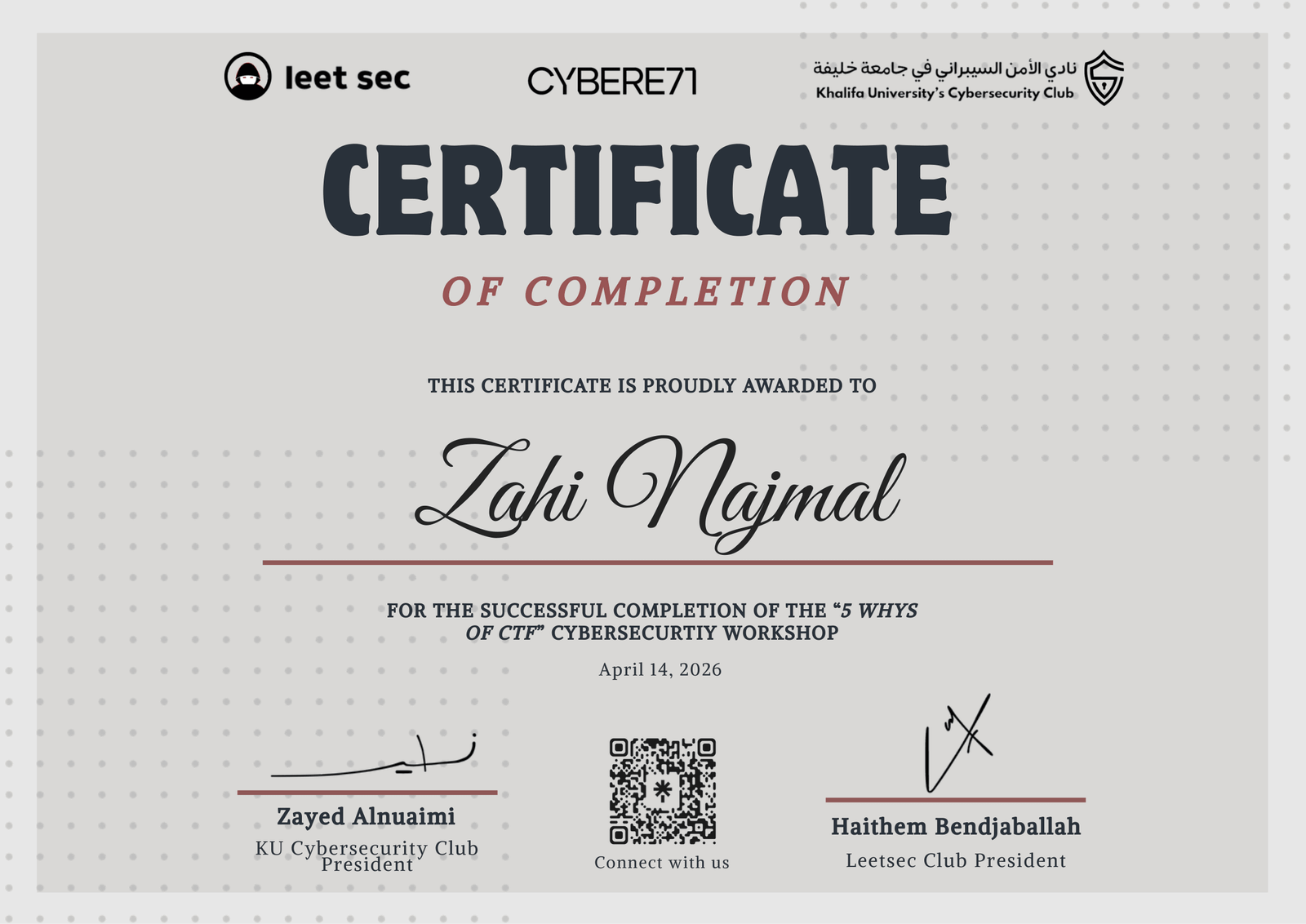
My experience completing a cybersecurity workshop exploring Capture The Flag challenges, technical problem-solving, and the fundamentals of cybersecurity.
I am pleased to share that I have successfully completed the “5 Whys of CTF” Cybersecurity Workshop, organised by the Cybersecurity Club at Khalifa University in collaboration with Leetsec, the 42 Abu Dhabi Cybersecurity Club.
As a student passionate about technology, programming, and building digital solutions, I am always interested in exploring new areas of computer science. Cybersecurity is one of those fields that particularly interests me because it combines technical knowledge, analytical thinking, creativity, and the ability to investigate problems systematically.
This workshop provided an opportunity to explore the fundamentals of Capture The Flag (CTF), understand the role of cybersecurity challenges in technical learning, and discover more about the problem-solving mindset used in security research.
About the “5 Whys of CTF” Program
The “5 Whys of CTF” workshop was designed as a beginner-friendly introduction to cybersecurity through Capture The Flag challenges. The session took place online through Microsoft Teams on 14 April 2026, from 5:30 PM to 7:30 PM.
The workshop was organised by Khalifa University’s Cybersecurity Club in collaboration with Leetsec, the 42 Abu Dhabi Cybersecurity Club. It was also supported by CyberE71 and the UAE Cyber Security Council.
What makes this kind of initiative valuable is its focus on making cybersecurity more approachable for learners. Cybersecurity can initially seem like a complicated field filled with unfamiliar terminology and technical concepts. However, CTF-based learning provides a way to explore these concepts through structured challenges, investigation, and practical problem-solving.
Rather than viewing cybersecurity only as a theoretical subject, CTF introduces learners to the process of examining digital systems, identifying weaknesses, analysing evidence, and working towards solutions.
For someone beginning to explore cybersecurity, this approach can help connect fundamental concepts with the kinds of problems encountered in the wider security community.
Understanding Capture The Flag (CTF)
Capture The Flag, commonly known as CTF, is a format of cybersecurity competition in which participants solve challenges to locate a hidden piece of information called a flag.
These flags are typically strings of text placed within a challenge or made discoverable by solving a particular problem. Participants use logical reasoning, technical knowledge, investigation, and sometimes specialised tools to determine how to find them.
CTF challenges can cover several areas of cybersecurity, including cryptography, web security, digital forensics, reverse engineering, and binary exploitation. Each category introduces a different way of thinking about how digital systems operate and how their weaknesses can be identified.
For example, a cryptography challenge might involve analysing an encoded message. A web security challenge could require investigating how a website handles input or manages access. A binary exploitation challenge may involve examining a compiled program to understand how a vulnerability could affect its behaviour.
Although these areas differ technically, they share an important principle: understanding a problem requires more than simply guessing an answer. It involves gathering information, forming hypotheses, testing possible explanations, and learning from the results.
CTF competitions are therefore useful for developing both technical knowledge and a structured approach to problem-solving. They also provide an environment in which learners can practise security techniques within deliberately designed challenges.
The Importance of Asking “Why”
The title “5 Whys of CTF” brings attention to a fundamental part of technical investigation: asking questions and looking beyond the surface of a problem.
In problem-solving, the Five Whys technique involves repeatedly asking why something happened to investigate its underlying causes. Instead of stopping at the first explanation, each answer becomes the starting point for another question.
This approach is particularly relevant to cybersecurity, where identifying a visible issue is not always enough to understand its cause.
Consider a simplified example of a website security problem.
- Why did unauthorised access occur? A security control may have failed.
- Why did the security control fail? The system may have handled an input incorrectly.
- Why was the input handled incorrectly? The application may not have validated it properly.
- Why was proper validation missing? A security requirement may have been overlooked.
- Why was that requirement overlooked? The development process may not have included sufficient security testing.
This example illustrates how repeatedly asking why can move an investigation from an immediate symptom towards a possible underlying cause. In real security investigations, the explanation would need to be verified with evidence rather than assumed.
The same mindset is useful when approaching CTF challenges. If an initial solution does not work, a learner can examine the assumptions behind it, investigate the available evidence, and try a different approach.
For me, this connection between curiosity and technical problem-solving is an important part of understanding cybersecurity. It reinforces the idea that asking better questions can be just as valuable as knowing which tools to use.
Exploring Different Areas of Cybersecurity
Cybersecurity is a broad discipline, and CTF challenges provide a way to become familiar with some of its major technical areas.
1. Web Security
Web security focuses on protecting websites, web applications, and the systems that support them.
Applications process user input, manage sessions, communicate with databases, and control access to information. Errors in these processes can introduce vulnerabilities that attackers may attempt to exploit.
Learning about web security helps developers understand why secure input handling, appropriate access controls, authentication, and careful application design are important.
As someone interested in programming and web development, I find this area particularly relevant. Building an application involves more than making its features work correctly; it also requires considering how the application behaves when users interact with it in unexpected ways.
2. Cryptography
Cryptography involves mathematical techniques used to protect information, verify authenticity, and support secure communication.
It includes concepts such as encryption, decryption, hashing, and digital signatures. These techniques help protect sensitive information and establish trust between digital systems.
Cryptography-related CTF challenges can involve identifying encoding schemes, analysing encrypted data, or recognising mistakes in how cryptographic methods are used.
Exploring this field demonstrates how mathematics, logical reasoning, and computer science work together to address practical security problems.
3. Binary Exploitation
Binary exploitation involves analysing compiled programs to understand and, in controlled environments, demonstrate how software vulnerabilities may be exploited.
This area can require knowledge of memory, program execution, data representation, and low-level computing concepts.
It also illustrates why understanding what happens beneath an application’s visible interface is important. Software can appear to work normally while still containing weaknesses in how it handles memory or processes input.
Binary exploitation is a more advanced area of cybersecurity, but learning about its place within CTF competitions helps illustrate the technical depth of the field.
4. Digital Investigation and Analytical Thinking
Across cybersecurity challenges, investigation plays an important role. A problem may not immediately reveal what is wrong or which technique is required.
Learners need to examine available information, recognise patterns, test ideas, and distinguish useful evidence from irrelevant details.
This analytical process is applicable beyond cybersecurity. It is useful in software debugging, programming competitions, system design, and many other technical disciplines.
Note: These areas provide context for CTF learning and were discussed in participant accounts of the workshop. They should not be interpreted as a verified, exhaustive list of every activity performed during my individual session.
From Theory to Practical Problem-Solving
One of the reasons CTF is an interesting approach to cybersecurity education is that it connects concepts with challenges that require active investigation.
Reading about a vulnerability can help explain what it is, but analysing a deliberately designed challenge can make the underlying idea easier to understand. It encourages learners to apply their knowledge rather than simply memorise definitions.
The process generally involves understanding the challenge, examining the available information, identifying possible approaches, testing hypotheses, and refining a solution.
Not every attempt will succeed immediately. Sometimes a proposed explanation will be incorrect, an approach will fail, or additional investigation will be needed. These setbacks are part of the learning process.
This is also why patience matters. Effective technical problem-solving often requires breaking a complicated issue into smaller questions and examining each one carefully.
In cybersecurity, these activities should take place within authorised environments, such as CTF platforms, training laboratories, and systems for which permission has been granted. Ethical boundaries are essential because the same technical knowledge can have very different consequences depending on how it is applied.
Why Cybersecurity Matters to Me as a Student and Developer
My interests in programming and technology have taught me that building a digital solution involves several interconnected responsibilities.
A website must be functional and accessible. An application should provide a useful experience. A system should also be designed with reliability, privacy, and security in mind.
Cybersecurity adds another perspective to the development process by encouraging us to think about how systems might fail, how information could be exposed, and how potential weaknesses can be prevented.
For example, when developing a web application, it is important to consider authentication, permissions, input validation, and the protection of user information. These are not features that should only be considered after a product has been built; they are important parts of responsible software development.
Experiences that introduce students to cybersecurity can therefore help broaden their understanding of computer science. They encourage developers to think not only about what their software can do, but also about how it behaves under unexpected conditions.
This is one of the reasons I want to continue learning about security alongside my other interests in programming and emerging technologies.
Key Takeaways from the Experience
Completing the “5 Whys of CTF” workshop was a valuable addition to my technology learning journey. It gave me another opportunity to explore cybersecurity and reflect on the skills and mindset involved in solving security-related problems.
Some of the key ideas I take away from this experience are:
Curiosity is essential. Asking questions and investigating how a system works can reveal information that is not immediately obvious.
Problem-solving requires patience. Complex technical challenges may require several attempts, careful reasoning, and a willingness to reconsider an approach.
Fundamentals matter. Understanding programming, networking, data representation, and system behaviour provides a useful foundation for exploring more advanced security topics.
Security should be part of development. Building reliable digital solutions means considering potential vulnerabilities and protecting systems from the beginning.
Learning is continuous. A single workshop is only an introduction to a much larger field. Consistent practice and further exploration are important for developing deeper technical knowledge.
These principles are relevant not only to CTF competitions but also to the broader process of learning computer science and developing practical technical skills.
Looking Ahead: Continuing My Cybersecurity Journey
Successfully completing this workshop is another milestone in my journey of exploring technology.
I want to continue building my understanding of cybersecurity through further learning, exploring CTF challenges, and developing a stronger foundation in the concepts that underpin secure digital systems.
There is still much to discover, from understanding network communication and application security to investigating vulnerabilities in controlled environments and learning how developers can prevent them.
I also believe that sharing these experiences is valuable. Documenting what I learn allows me to reflect on my progress, communicate technical ideas, and keep track of the opportunities that contribute to my development.
Through ZahiTech, I aim to document my experiences across technology, programming, artificial intelligence, and other areas of computer science while continuing to learn and build.
Acknowledgements
I would like to thank Khalifa University’s Cybersecurity Club for organising the “5 Whys of CTF” workshop, together with Leetsec, the 42 Abu Dhabi Cybersecurity Club.
I also appreciate the support of CyberE71 and the UAE Cyber Security Council in making the initiative possible.
Opportunities like this help make technical learning more accessible and encourage students to explore fields that extend beyond the classroom.
Final Thoughts
The “5 Whys of CTF” Cybersecurity Workshop was a meaningful step in my continuing exploration of computer science.
It reinforced the importance of curiosity, structured investigation, and critical thinking when approaching technical problems. It also highlighted how CTF challenges can provide an entry point into the wider world of cybersecurity.
As I continue developing my skills in programming and technology, I look forward to exploring more security concepts, taking on new challenges, and learning how to build digital solutions with security in mind.
Every new experience adds another perspective to the way I understand technology, and this workshop is another step forward in that journey.