Machine Learning has always been one of the fields that fascinated me the most. The idea that computers can learn from data, identify patterns, make predictions, and improve their performance without being explicitly programmed inspired me to explore Artificial Intelligence more deeply.
My journey into Machine Learning became more structured when I started the three-course Machine Learning specialization from Stanford University, taught by Professor Andrew Ng through Coursera. These courses provided me with a complete learning path, starting from the fundamentals of Machine Learning and gradually moving towards advanced Artificial Intelligence concepts.
The three courses that shaped my understanding in Machine Learning were:
- Supervised Machine Learning: Regression and Classification
- Advanced Learning Algorithms
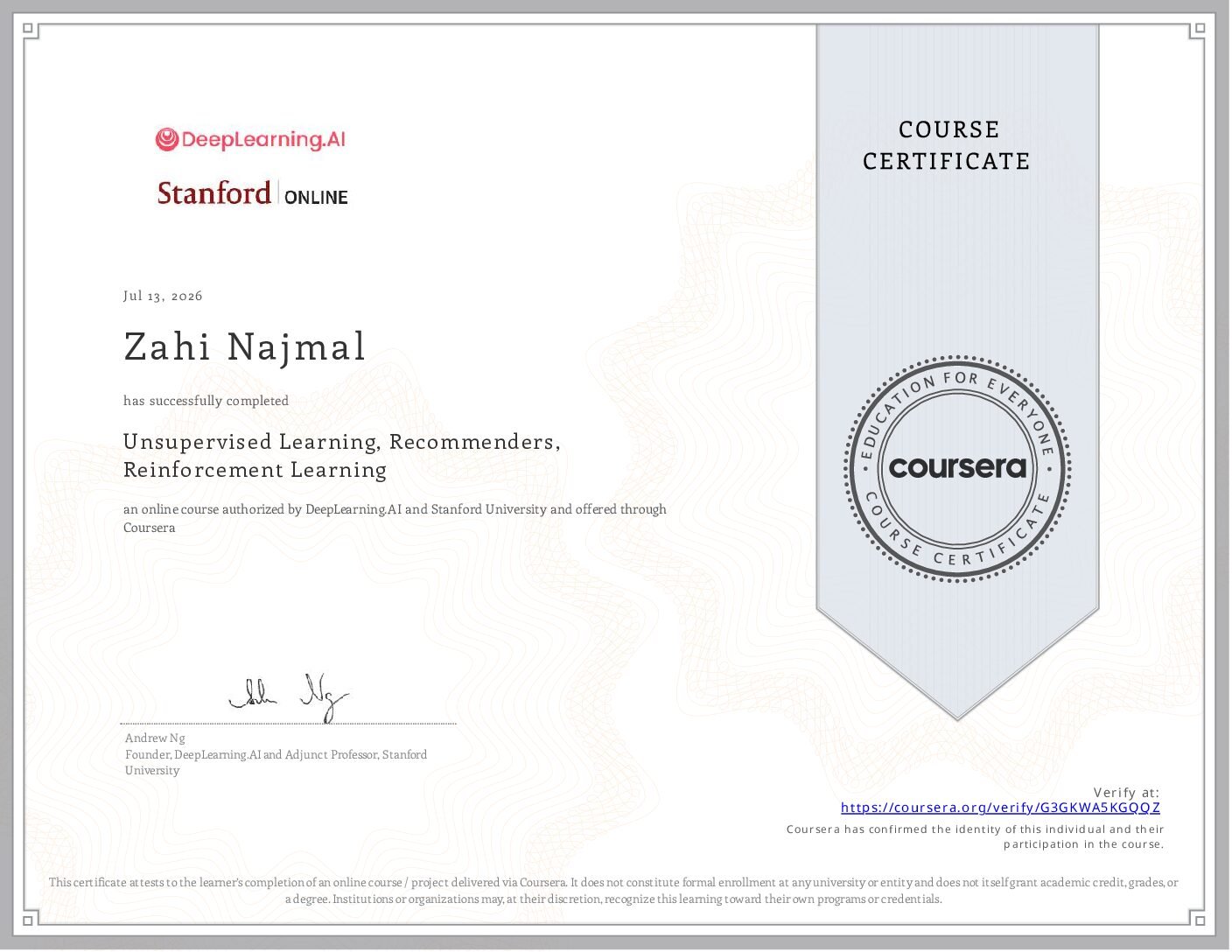
- Unsupervised Learning, Recommenders, Reinforcement Learning
Together, these courses helped me understand how modern AI systems work, from simple prediction models to complex intelligent systems.
Building My Foundation with Supervised Machine Learning: Regression and Classification
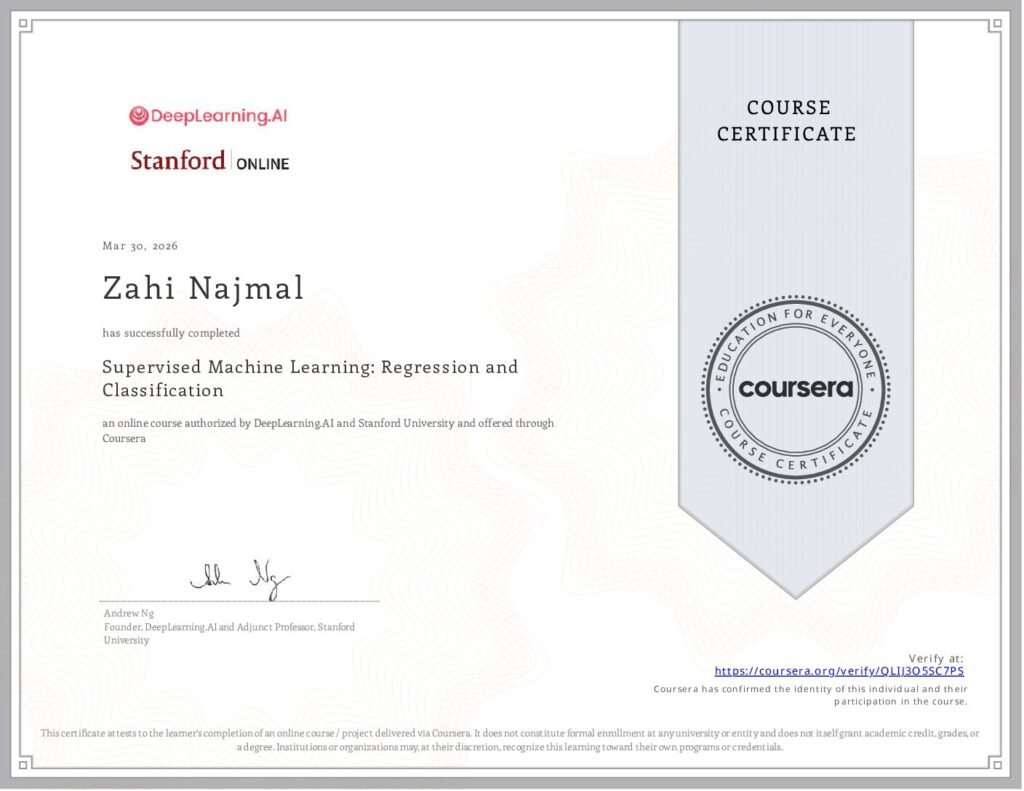
The first step of my Machine Learning journey began with understanding supervised learning. This course introduced me to the fundamentals of how machines learn from labeled datasets.
I learned how algorithms can analyze existing examples and use them to predict outcomes for new data. One of the first concepts I explored was linear regression, where models learn relationships between input variables and continuous outputs.
Understanding concepts like cost functions and gradient descent was a major milestone because it explained how Machine Learning models actually improve themselves. Instead of viewing AI as a “black box,” I started understanding the mathematical processes happening behind the scenes.
The course also introduced classification techniques, including logistic regression, which is widely used for tasks where predictions belong to different categories.
Through this course, I gained knowledge about:
- Training and evaluating Machine Learning models
- Reducing errors using optimization techniques
- Feature selection and model improvement
- Understanding bias and variance
- Preventing overfitting through regularization
This foundation helped me understand the core principles behind predictive AI systems.
Exploring Advanced Learning Algorithms and Neural Networks
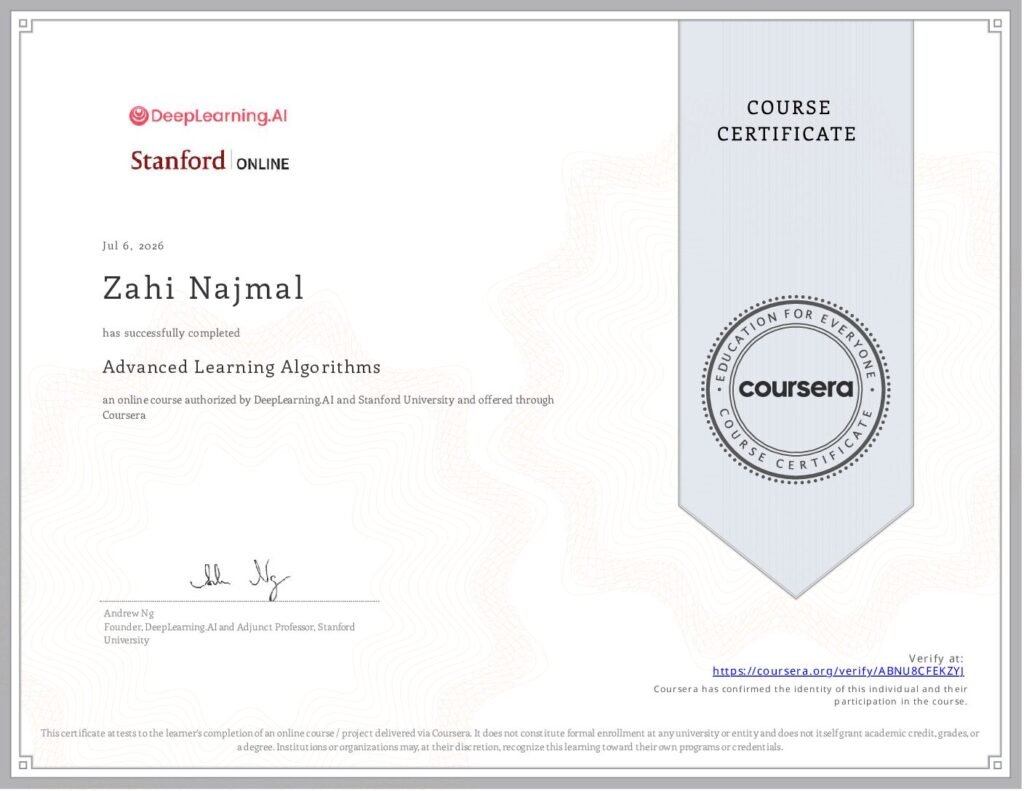
After completing the fundamentals, I moved into the second course, Advanced Learning Algorithms. This was where my understanding of Artificial Intelligence became much deeper.
One of the most exciting topics was neural networks. Learning how artificial neurons work and how layers of neurons can process complex information helped me understand the foundation behind modern deep learning systems.
I explored how neural networks are trained, how activation functions allow models to learn complex patterns, and how frameworks such as TensorFlow are used to build and train AI models.
The course also introduced important Machine Learning techniques such as:
- Neural network architecture and training
- TensorFlow implementation
- Decision trees
- Random forests and ensemble learning
- Model optimization techniques
This course connected the theoretical concepts of Machine Learning with practical implementation. It showed me how the same ideas behind simple Machine Learning models can scale into powerful AI systems used in real-world applications.
Discovering Patterns with Unsupervised Learning, Recommender Systems, and Reinforcement Learning
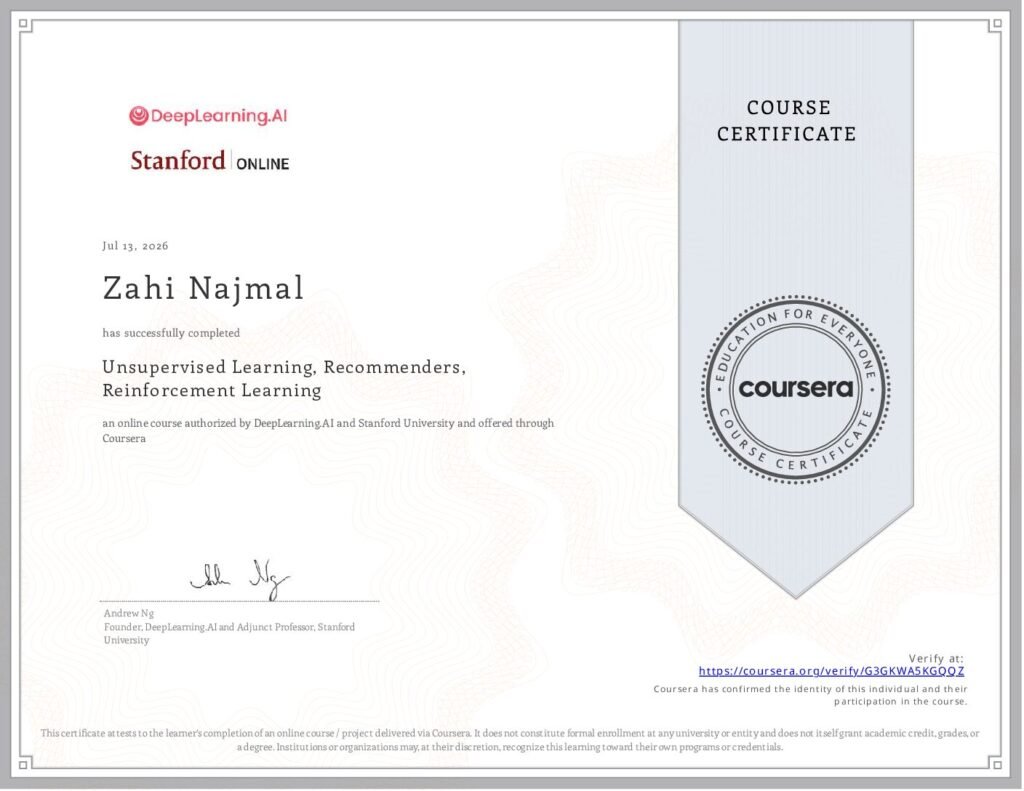
The final course, Unsupervised Learning, Recommenders, Reinforcement Learning, introduced me to some of the most advanced and interesting areas of Artificial Intelligence.
Unlike supervised learning, where models learn from labeled examples, unsupervised learning allows computers to discover hidden patterns within data.
I learned about clustering algorithms, especially K-Means clustering, and how these methods can group similar data points together without requiring predefined categories.
Another fascinating topic was recommender systems. These systems power many of the platforms we use every day, including content recommendations, product suggestions, and personalized experiences. Understanding how recommendation algorithms work gave me insight into the AI systems behind modern technology platforms.
The course also introduced reinforcement learning, where an AI agent learns by interacting with an environment and improving through rewards and feedback.
Through this course, I explored:
- Unsupervised learning techniques
- K-Means clustering
- Anomaly detection
- Collaborative filtering
- Recommender systems
- Reinforcement learning concepts
This final stage completed my understanding of the different ways machines can learn and make intelligent decisions.
Reflection on My Machine Learning Experience
Completing these three Stanford University courses has been one of the most valuable learning experiences in my Artificial Intelligence journey.
The courses did not only teach me algorithms and mathematical concepts; they changed the way I think about technology. I learned how data, mathematics, and programming combine to create systems capable of solving complex problems.
From building my first understanding of regression models to exploring neural networks, recommender systems, and reinforcement learning, every stage of this journey helped me develop a stronger foundation in Machine Learning.
I am excited to continue applying these skills through practical projects, experimenting with new AI technologies, and creating solutions that use Artificial Intelligence to solve real-world challenges.
This journey is only the beginning.