An insightful learning experience exploring the world of cybersecurity through ThinkCloudly’s Cybersecurity Bootcamp, gaining a deeper understanding of digital threats, network security, ethical hacking, malware investigation, and the importance of protecting digital systems.
I am pleased to share my experience with the ThinkCloudly Cybersecurity Bootcamp, an online learning experience that introduced me to several important areas of cybersecurity and helped me explore how security professionals identify threats, understand vulnerabilities, and protect computer systems.
As someone interested in technology, programming, and cybersecurity, I find it fascinating to understand not only how digital systems work but also how they can be attacked, secured, and made more reliable. This bootcamp provided an opportunity to explore these topics through a structured series of sessions covering different aspects of the cybersecurity field.
Throughout the bootcamp, I explored concepts related to cybersecurity fundamentals, network security, reconnaissance, malware analysis, threat investigation, and incident response. These subjects helped me appreciate how many different skills and areas of knowledge contribute to protecting systems in an increasingly connected world.
In this article, I will share what the bootcamp covered, the concepts I learned about, why cybersecurity matters, and how this experience contributes to my continuing technology journey.
About the ThinkCloudly Cybersecurity Bootcamp
ThinkCloudly organised the Cybersecurity Bootcamp as a five-session learning programme designed to introduce participants to key cybersecurity concepts and their practical relevance.
The programme’s published curriculum covered five major areas, progressing from foundational cybersecurity knowledge to network security, ethical hacking, malware investigation, incident response, and career awareness.
What makes cybersecurity particularly interesting is that it involves much more than simply identifying suspicious activity. It requires understanding how systems communicate, recognising potential weaknesses, analysing evidence, and thinking carefully about how security incidents can be prevented or handled.
The bootcamp’s session structure provided a way to explore these different areas and understand how they connect to one another.
For me, it was an opportunity to expand my understanding of a field that plays a critical role in the technology we use every day.
You can explore the official programme here:
ThinkCloudly Cybersecurity Bootcamp: https://thinkcloudly.com/bootcamp/fio5/
Exploring the Five Sessions
One of the interesting aspects of the bootcamp was the range of subjects included in its curriculum. Each session focused on a different part of cybersecurity, helping build a broader picture of how digital systems can be protected.
Session 1: Cybersecurity Fundamentals and Ethical Hacking
The first session focused on cybersecurity fundamentals and ethical hacking.
Cybersecurity involves protecting computers, networks, applications, and information against unauthorised access, misuse, disruption, and other digital threats.
Understanding the fundamentals is important because security decisions depend on knowing what needs protection, what kinds of threats exist, and how weaknesses can affect a system.
An important concept in cybersecurity is the distinction between identifying vulnerabilities and exploiting them without permission. Ethical hacking involves examining systems within an authorised scope to identify weaknesses so that they can be addressed before malicious actors take advantage of them.
This topic highlights the importance of responsible security research. Technical knowledge must be accompanied by permission, clear boundaries, and respect for privacy.
I found this area particularly relevant because it demonstrates how programming and technical problem-solving can be used not only to build software but also to improve its security.
It also reinforced an important principle: understanding how systems can fail is an essential part of learning how to make them more secure.
Session 2: Network Security and Traffic Analysis
The second session covered network security and traffic analysis.
Modern digital systems depend on networks to exchange information. Websites, applications, cloud services, and connected devices all rely on communication between different systems.
Network security focuses on protecting these communications and the infrastructure that supports them.
Traffic analysis involves examining network communication to understand what is happening, identify unusual patterns, and investigate activity that may require further attention.
For example, security professionals may examine communication patterns to investigate unexpected connections, unusual traffic volumes, or other signs that something might be wrong. Such observations need to be interpreted carefully because unusual activity does not automatically mean an attack has occurred.
Learning about this area helped me appreciate the importance of visibility in cybersecurity. Protecting a system is not only about setting up security measures; it is also about understanding what is happening within the environment being protected.
Network security is especially important as more services depend on internet connectivity and distributed infrastructure.
Session 3: Ethical Hacking and Reconnaissance
The third session explored ethical hacking and reconnaissance.
Reconnaissance is the process of gathering information about a target before a security assessment or investigation. In an authorised security assessment, this helps establish what is known about the target and which areas may require closer examination.
This concept demonstrates why information gathering is an important part of security work.
Before attempting to assess a system, a security professional needs to understand the scope of the assessment, identify relevant information, and determine which areas should be examined.
Reconnaissance can involve different approaches depending on the environment and the permissions granted. Responsible practitioners must remain within the authorised scope of their work.
What makes this topic interesting is that cybersecurity often begins with observation and analysis rather than immediately taking action.
It also highlights the importance of methodical thinking. A structured approach to gathering and evaluating information can help security professionals make better decisions during an assessment.
Session 4: Malware Analysis and Threat Investigation
The fourth session covered malware analysis and threat investigation.
Malware is software designed to perform harmful or unauthorised actions. Different forms of malware can attempt to steal information, disrupt operations, gain unauthorised access, or interfere with the normal functioning of a computer system.
Malware analysis focuses on examining suspicious software to understand its behaviour, capabilities, and potential impact.
Threat investigation is a broader process that involves collecting and analysing information to understand a potential security incident.
These activities are important because identifying a suspicious file is only one part of understanding a threat. Investigators also need to consider what the file may have done, which systems could be affected, and what evidence might help explain the incident.
This area showed me how cybersecurity combines technical knowledge with careful investigation.
It also illustrates why security professionals must work methodically. Conclusions should be based on evidence rather than assumptions, and suspicious files should be handled using appropriate isolation and safety procedures.
I find this investigative side of technology especially interesting because it involves asking questions, examining evidence, identifying patterns, and working towards a logical explanation.
Session 5: Cybersecurity Best Practices, Incident Response, and Careers
The fifth session brought together cybersecurity best practices, incident response, and career-related topics.
Cybersecurity best practices help reduce the likelihood and impact of security incidents. Examples include using strong and unique passwords, enabling multifactor authentication, applying software updates, maintaining backups, and being cautious with unexpected links and attachments.
Incident response focuses on how an organisation handles a suspected or confirmed security incident.
A structured response may involve identifying the incident, assessing its scope, containing the threat, removing its cause, recovering affected systems, and reviewing what happened to improve future security.
This highlights an important point: cybersecurity is not limited to preventing every possible attack. Organisations also need plans for detecting incidents, responding effectively, and recovering safely.
The session also covered careers in cybersecurity, an important subject for understanding how these technical skills fit into the wider technology industry.
Cybersecurity includes a variety of specialisations, such as security analysis, penetration testing, incident response, digital forensics, and security engineering. Each area requires its own combination of technical knowledge, practical experience, and professional responsibility.
Exploring these topics helped me understand how broad the cybersecurity field is and how different skills can contribute to protecting digital environments.
What I Learned from the Bootcamp
The bootcamp’s curriculum introduced me to several important concepts that connect to one another in the wider cybersecurity field.
1. Security Requires a Broader Understanding of Technology
Cybersecurity cannot be understood in isolation. It depends on knowledge of computer systems, networks, applications, software behaviour, and the ways information moves between different components.
Understanding these connections makes it easier to recognise where weaknesses may exist and why security measures need to be considered throughout the development and operation of a system.
2. Ethical Hacking Must Be Responsible
Ethical hacking is not simply about discovering vulnerabilities. It involves working with permission, following an agreed scope, protecting information, and reporting findings responsibly.
This distinction is essential because the same technical knowledge can be used in very different ways depending on the intentions and actions of the person using it.
Responsible cybersecurity work must always respect legal and ethical boundaries.
3. Network Activity Can Provide Valuable Clues
Network traffic can help investigators understand communication between systems and identify activity that deserves further investigation.
However, interpreting traffic requires context and careful analysis. A single unusual connection or pattern is not enough to establish that an attack has occurred.
This reinforces the importance of combining technical observation with logical reasoning.
4. Threat Investigation Depends on Evidence
Malware analysis and threat investigation demonstrate the importance of gathering evidence, examining behaviour, and drawing conclusions carefully.
Instead of immediately assuming what happened, investigators need to examine available information and develop an explanation supported by the evidence.
This approach to problem-solving is useful far beyond cybersecurity. It is also relevant to debugging software, investigating technical failures, and solving complex programming problems.
5. Prevention and Response Are Both Important
Strong security practices help reduce risks, but organisations must also prepare for incidents that may still occur.
Understanding incident response highlights the importance of preparation, detection, containment, recovery, and continuous improvement.
A reliable security strategy must consider both how to reduce the likelihood of incidents and how to handle them when they happen.
Connecting Cybersecurity with My Interest in Programming
My interest in technology extends across programming, software development, and exploring how digital systems work.
Cybersecurity adds another dimension to that interest by focusing on how systems behave under potential threats and how they can be designed and maintained more securely.
When developing a web application, for example, it is important to consider not only whether its features work as intended but also whether user information is handled appropriately, access is controlled correctly, and potential vulnerabilities are addressed.
The same principle applies to connected devices, databases, APIs, and cloud-based applications.
Learning about cybersecurity encourages developers to think beyond functionality and consider reliability, privacy, access control, and the consequences of security failures.
I believe this perspective is valuable for anyone who builds technology. Security should not be treated as an afterthought added only when a problem appears; it should be considered throughout the development process.
Why Cybersecurity Matters in Today’s Digital World
Technology has become an essential part of education, communication, business, healthcare, and everyday life.
As more information and services move online, protecting digital systems becomes increasingly important.
Cybersecurity helps individuals and organisations safeguard sensitive information, maintain the availability of services, protect users from digital threats, and respond to security incidents.
The consequences of poor security can extend beyond technical problems. They may include privacy violations, financial losses, interrupted services, and damage to trust.
This makes cybersecurity relevant to developers, students, businesses, institutions, and anyone who uses digital technology.
Understanding basic security principles can help individuals make safer decisions online, while deeper technical knowledge can support the development and protection of more complex systems.
The ThinkCloudly bootcamp provided a structured opportunity to explore several of these areas and understand how they contribute to a larger security strategy.
The Importance of Continuous Learning
Technology changes constantly, and cybersecurity is no exception.
New vulnerabilities, attack techniques, defensive tools, and security challenges continue to emerge. As a result, cybersecurity professionals must continually update their knowledge and adapt to changing environments.
A structured bootcamp can serve as a starting point for exploring a subject, understanding its terminology, and identifying areas for further study.
However, developing strong technical skills requires continued learning, practice, and experience beyond an introductory programme.
For me, this experience reinforces the value of approaching technology with curiosity and a willingness to explore unfamiliar subjects.
It also encourages me to continue learning about how systems work, how they can be secured, and how technical knowledge can be applied responsibly.
Receiving My ThinkCloudly Bootcamp Certificate
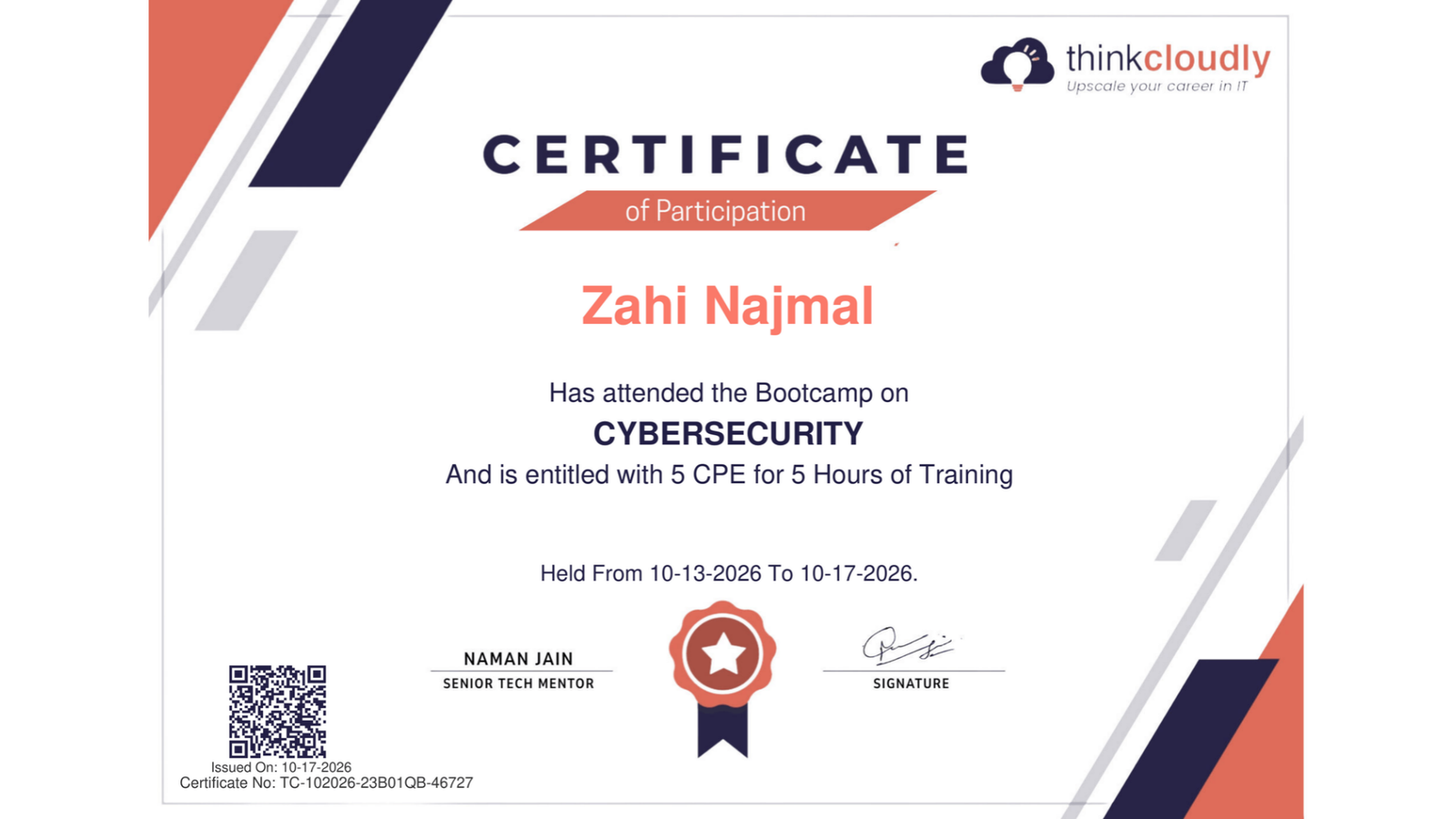
[Featured image: My ThinkCloudly Cybersecurity Bootcamp certificate.]
Receiving a certificate provides a meaningful way to document participation in a learning experience and recognise the effort invested in exploring a new subject.
For me, this certificate represents an opportunity to expand my understanding of cybersecurity and explore concepts that are important in today’s technology landscape.
It also becomes part of my growing technology portfolio, documenting my continued interest in learning about different areas of computing.
While a certificate is a useful record of achievement, I believe the knowledge gained and the motivation to continue learning are equally important.
The concepts covered in this bootcamp give me a foundation for further exploration of cybersecurity, from network analysis and ethical hacking to malware investigation and incident response.
Looking Ahead: Continuing My Technology Journey
My ThinkCloudly Cybersecurity Bootcamp experience has encouraged me to continue exploring the relationship between technology, security, and responsible software development.
I want to keep developing my technical knowledge and understanding how different areas of computing connect. Learning about cybersecurity provides another perspective on the systems developers build and the challenges involved in protecting them.
As I continue working on technology projects, I hope to apply a stronger awareness of security principles and consider how applications can be made more reliable and responsible.
I am particularly interested in continuing to explore programming and cybersecurity together, understanding how secure development practices can help create better digital experiences.
Every learning opportunity contributes something different to a technology journey. This bootcamp added another perspective to mine and strengthened my motivation to keep learning, experimenting, and building.
Acknowledgements
I would like to thank ThinkCloudly for providing the Cybersecurity Bootcamp and organising sessions covering important areas of cybersecurity.
I appreciate the opportunity to explore topics such as cybersecurity fundamentals, network security, ethical hacking, reconnaissance, malware analysis, threat investigation, and incident response through a structured programme.
I would also like to thank my teachers for encouraging me to continue learning beyond the classroom and exploring opportunities to develop my technical knowledge and skills.
Experiences like these remind me that learning does not end with a single subject or course. It continues through curiosity, practice, and the willingness to understand how technology works.
Final Thoughts
The ThinkCloudly Cybersecurity Bootcamp was a valuable opportunity to explore the fundamentals of digital security and gain a broader understanding of the different areas involved in protecting computer systems and networks.
From ethical hacking and reconnaissance to network security, malware investigation, and incident response, the programme introduced concepts that demonstrate the importance of technical knowledge, careful analysis, and responsible practice.
The experience also reinforced the connection between cybersecurity and software development, showing why security awareness is important when building and maintaining digital systems.
I look forward to continuing my learning journey, exploring more advanced concepts, and applying what I learn to future technology projects.
For me, this bootcamp is another step towards becoming a more knowledgeable and responsible technology developer.